
The Terror of Easter
Atheism is the Opiate of the Masses

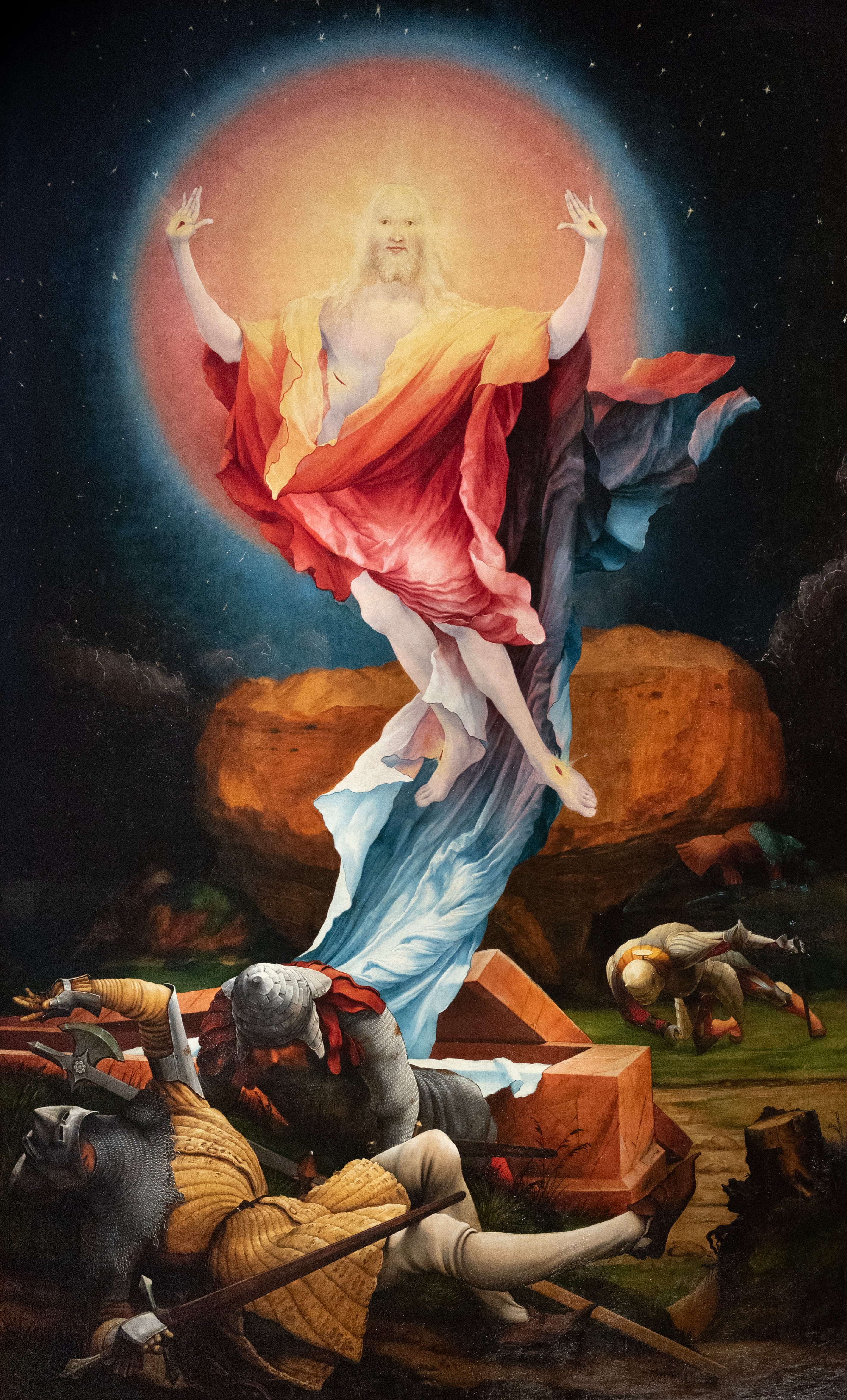
“There was a violent earthquake, for an angel of the Lord came down from heaven and, going to the tomb, rolled back the stone and sat on it. His appearance was like lightning, and his clothes were white as snow. The guards were so afraid of him that they shook and became like dead men.”
—Matthew 28:2-4
“Religion is the opiate of the masses.”
—Karl Marx
I used to think this claim had at least some merit. And I suppose to the degree a given religion gets reduced to mere wishful thinking about some version of an upgraded “afterlife,” Marx is right. But no religion reduces itself to such platitudes, despite what some of its adherents might at a popular level. As for the claims of the Gospel, and specifically the resurrection of the dead, I’m left to conclude precisely the opposite: atheism is the opiate of the masses.
If Jesus stayed in the tomb, it means that the world can continue on its course, unaccountable, free of any absolutes—other than death—so we can shrug off that nagging Voice of our conscience without consequence, that Voice that you can never quite prove but always seems to somehow prove you, that ever confronts us with an immediate awareness of all those unyielding realities like two plus two and betrayal is bad and a sunrise is beautiful and justice is right but compassion is good and mercy is holy.
If Jesus stayed in the tomb, it will finally silence that Voice we as a species have attempted to “autotune,” to mechanize and so depersonalize, by isolating its third-person harmonies and mythologizing them as “natural laws,” by some magic, with no law-giver, without irony. It’s the Voice of that inner-yet-distant harmony that ever-reveals this world’s discord and our own souls’ dissonances, exposing our evil with immediacy against an eternal I-Thou union of Love at the foundation of things, without which the difference of dissonance could not exist, much less be heard, without which Bach is no different than Nickelback, generosity is no better than greed; but with which we can see the image of God in our child’s eyes, with which we can learn to see it in our enemy’s. We’re called to. We’re told to.
It’s the Voice that tells us what love is and calls us forth to become truly human, to love, and because it’s all for love it’s a Voice that gives freedom, that calls forth and steps back to give space, and just for that reason is so easy to ignore, whether we gradually tune it out over time or hastily grab at the knobs each day. Either way, the Voice remains, ever still and small like a whisper, ever weak and persistent like gravity, ever and intimately near and all-encompassing like a whisper and like gravity—the Voice that creates the very Light for us to reflect God’s image but therefore the Same that reveals our shadows.
But if Jesus stayed in the tomb, there is no Lord to answer to, no Voice from without, only fleeting, if competing, echoes from within, and at any rate all voices are moving toward a finality of silence. All fades to black.
That, to me at least, seems much easier to deal with than the prospect of the destruction of death itself, of darkness itself, the prospect that I will be raised from the dead into a light that will expose the truth behind all my words and deeds and the thoughts and intentions of my heart (Mk. 4:22; Lk. 12:2; Jn. 3:19-21; 1 Cor. 3:13; Heb. 4:12-13; et al). It’s much easier to imagine death brings a certain finality to all that I have done and not done, said and not said, all that I have thought and intended, to all the willfully missed opportunities to love and help and give and forgive, to my violence, my greed, my self-indulgence, my insistence that ‘my will be done.’
Practically speaking, I confess there are many days my will seems to dominate all inner dialogue and decision making, with little to no second thought of Another will, another Voice, so the thought that I do indeed have a Lord who will greet me in judgment to examine the substance of my confession—Jesus Christ is Lord—is, quite frankly, unsettling; the thought that he warned about people in the end who confessed to know him as Lord—based on their use of power in his name—but did not truly know him is properly terrifying.
I can’t help but think it would be far easier to make peace with death if I could anticipate a closure to all of my deeds and misdeeds, rather than anticipating that my life and my will and my secret thoughts and intentions are wide open to an eternal future, a future in which I am decidedly not Lord and death is not an option, a future from which that nagging Voice I’ve so often ignored has, all along, been issued from a throne, a throne that alone is Absolute.
But Jesus did not stay in the tomb.
“But in fact Christ has been raised from the dead, the firstfruits of those who have fallen asleep…But each in his own order: Christ the firstfruits, then at his coming those who belong to Christ. Then comes the end, when he delivers the kingdom to God the Father after destroying every rule and every authority and power. For he must reign until he has put all his enemies under his feet. The last enemy to be destroyed is death.”
—1 Corinthians 15:20-26
There was terror that first Easter (Mt. 28:1-10; Mk. 16:1-8; Lk. 24:36-43). And I suppose we shouldn’t be surprised. The world has lost its autonomy. Death no longer affords any escape routes. Life is laid bare to an infinite existence that we know now only as a Voice, and often just a faint Whisper, but then we shall see Him face to face.
What a glorious—what a terrifying—day that will be.
“Then I turned to see the Voice that was speaking to me…and when I saw Him, I fell as though dead. But he laid his right hand on me, saying, “Fear not, I am the first and the last, and the living one. I died, and behold I am alive forevermore, and I have the keys of Death and Hell.”
—Revelation 1:12-18
What if death isn’t the end of accountability? That question deserves engagement on its own terms, whatever your starting position.
“… the Voice of that inner-yet-distant harmony that ever-reveals this world’s discord and our own souls’ dissonances…”
The voice that brings order to my chaos inside. I imagine all of that chaos and sin being stripped from me in the presence of my God - what a painfully beautiful moment that will be. May it be so. Peace over chaos. Give me judgement, Lord, so I may experience peace forevermore.