
Remember *When* You Are
2025 Advent Reader

ad·vent / ˈadˌvent: the arrival of a notable person, thing, or event; to come to
“From of old no one has heard or perceived by the ear, no eye has seen a God besides you, who acts for those who wait for him” (Isa. 64:4).
It’s almost time for Advent. Advent is both a matter of history and a matter of festivity. It is, in the first place, a matter of history because before Advent is an annual holiday for Christians across the world it is the single event of Christ coming into the world: the Incarnation, the embodiment, of the Son of God. Christians celebrate Advent annually not only to remember Christ coming into the world but also to anticipate the Christ coming into the world again. The first Advent came with the promise of a second Advent. We can greet an otherwise uncertain future with a certain hope that Christ will arrive there, then, to receive us, dead or alive, into his eternal life. The Church’s Memorial Acclamation thus resounds daily in worship services across the globe: Christ has died! Christ has risen! Christ will come again! Christian memory is at once a form of anticipation. History has taken the shape of a promise.
Advent is the season set aside for waiting, the time we remember how to anticipate God’s promised future by remembering how God kept his promise to usher in a new future through his Messiah, our Lord Jesus Christ. We remember that our God is a God who delivers on his promises, even if it means being delivered “outside the inn,” even if it means being born in a barn and laid in a manger.
Thus the festivity begins as we reenter the story, shepherds in the field, angels in the sky. Salvation history is also a matter of festivity. Christian festivity is the embodied memory of the community of faith. Each year we reenter the live nativity of the liturgical calendar and decorate the world with salvation history, singing festive hymns that fill the air with hope. Our public festivity reminds us and each other and the whole world the story its and we’re a part of, it and we belong to, and so situates and (re)orients us in the actual history in which we are living, in which the world is spinning, the world where Christ has come, where Christ is coming again.1
Advent marks the beginning of the Christian (liturgical) year. The birth of Jesus doesn’t begin on Christmas Day any more than the Bible begins with Matthew’s Gospel. The birth of the eternal Son of God into the mortal human family was the fulfillment of a promise in history long before it was an event in history. So the Christian year begins with a longing for Christmas. That is what Advent is all about. It’s about cultivating our longing for the coming of Jesus.
The most basic meaning of the word advent is to ‘come to’, not simply ‘to come’ but specifically to ‘come to‘. It implies a specific place where anticipation is met with arrival. During the season of Advent, the Church actively waits for Christ to come again into our world by waiting on Christmas to come again into our world. If Christmas is the time for gifts and celebration, Advent is the time for restraint and anticipation. We are ushered into this season not with the rush of Black Friday traffic but with the Silent Night of Israel’s longing:
O come, O come, Emmanuel
To ransom captive Israel
That mourns in lonely exile here
Until the Son of God appears
Rejoice, Rejoice, Emmanuel
Shall come to thee, O Israel
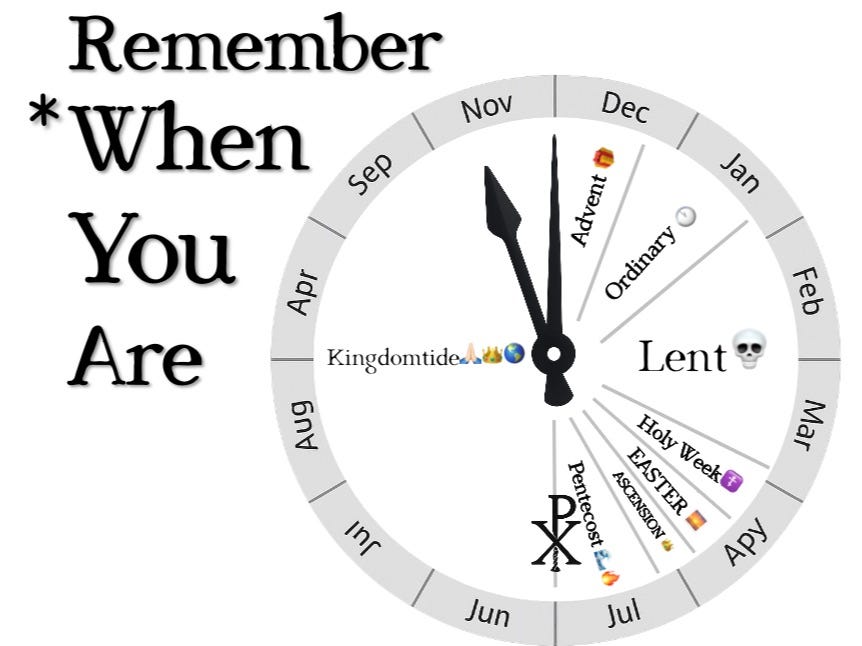
This all begins the fourth Sunday before Christmas and concludes on Christmas Day, which is the Church’s New Year’s Day. A few months after Christmas the Church enters the season of Lent, which culminates in the Passion Weekend (the Paschal Triduum), concluding on Easter Sunday. Forty days after Easter is the celebration of the ascension of Jesus to his throne in heaven. And finally, fifty days after Easter, the Christian festive year concludes with Pentecost, remembering the day the Holy Spirit flooded the earth and filled the Church.
To remember the event of Pentecost and the story that led to it is to understand what time it is in salvation history right now, at present. It is our orientation for everyday life. God’s Spirit has been poured on all flesh and the Church has been sent as witnesses of Jesus Christ so that those who believe may be saved from their sins and filled with the Spirit. The Church’s festivity is matter of Christian identity! And it’s one way that we bear witness to the world about the identity of its and our Lord. Indeed:
For Christ, our Passover lamb, has been sacrificed. Therefore let us keep the festival, not with the old leaven, the leaven of malice and evil, but with the unleavened bread of sincerity and truth.
—1 Corinthians 5:7-8
And so it is time. It’s time to wait for the God “who acts for those who wait on him” (Isa. 64:4). It’s time to enter again the world of waiting, the world of promise, the world where God has come with a promise to come again, and to bring with him an incomparably greater world—this one.
In the Old Testament, God commanded his people by Law(!) to ‘reenact’ salvation history annually through a series of seven festivals, from the Passover to the Feast of Tabernacles, with feasts and community celebrations that cultivated the embodied hope in each generation (Exod. 23; Deut. 16; Lev. 23). It was this living memory of a saving-God that helped each generation of a needing-saved people find hope in the God of their salvation. All the Jewish festivals about God’s past salvation lead up to the Day of Atonement—God’s present salvation—so that each successive generation would know the God who atoned for their sins was the Same “brought them out of the land of Egypt, out of the house of slavery,” who led them through the wilderness and gave them his Law in Sinai. Remembering God’s salvation in the past is the basis for anticipating God’s salvation in their future—in their annual pilgrimage toward Atonement.
The Church has adopted the wisdom of remembering from God’s Law and structured its annual calendar around salvation history under the New Covenant: the birth, life, death, resurrection, and ascension of Jesus and the sending of the Holy Spirit: this is our salvation. Our festivity thus brings us in feasts of nativity and angels singing to remember God’s saving act of being made flesh and tabernacling among us!